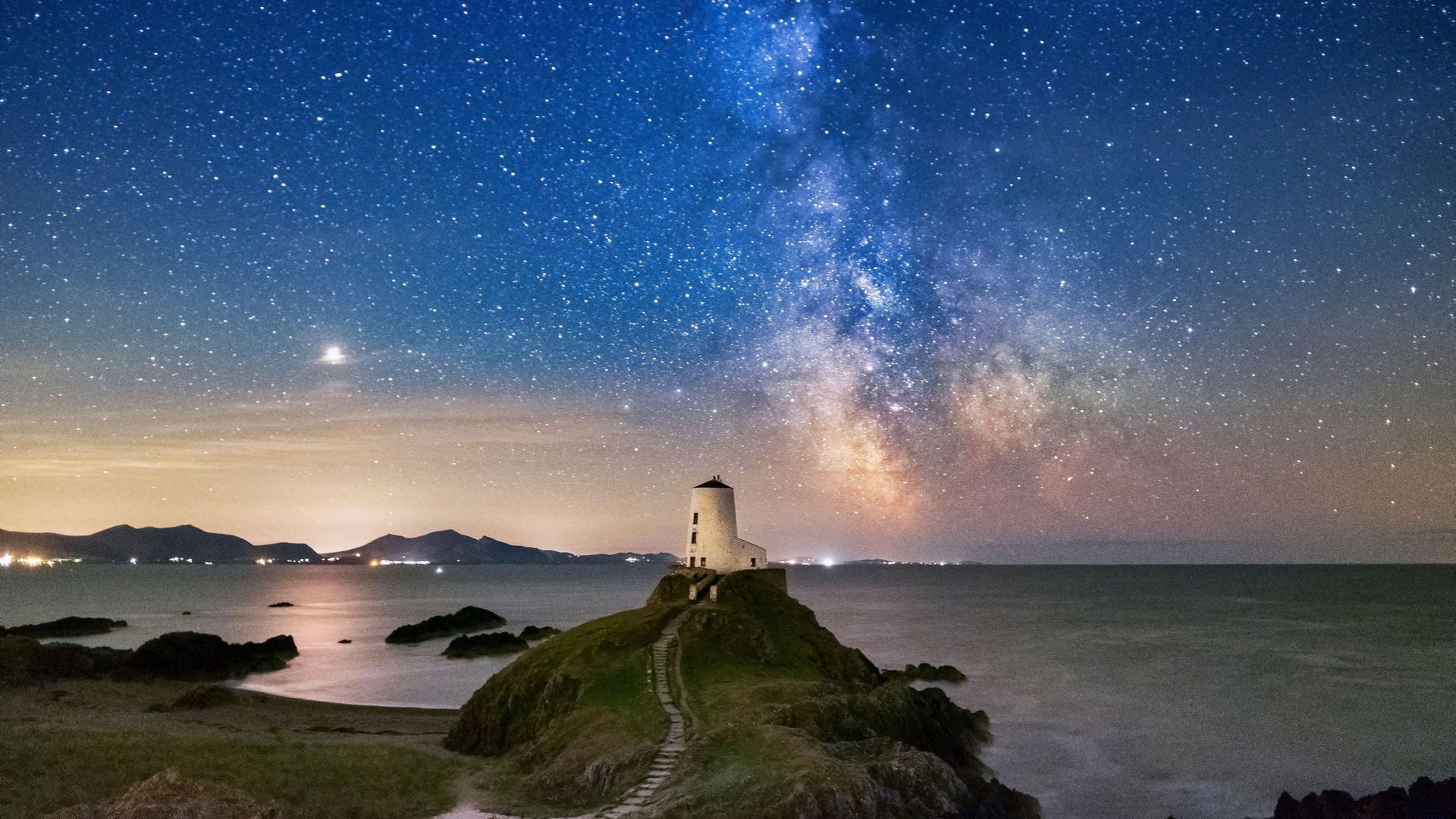
Marvel at the unspoilt glory of the highlands while you can. On Tuesday the UK revealed the winners of its latest auction for new wind farms, with all but four of the 22 onshore sites planned for Scotland.
Also this week, Starlink launched another 21 satellites into low Earth orbit. It already has more than 6,000 up there, and the plan is for a “megaconstellation” comprising seven times as many. Your kids will never again see a clear night sky.
I weep at such announcements — on aesthetic grounds alone. Where I live on the South Downs is one of only 21 designated international dark sky reserves in the world. When Elon Musk’s string of tin cans passes overhead, they almost cast a shadow.
It amazes me that no one seems too bothered. My fellow kite surfers on the south coast of England think I’m crazy to moan that the Rampion offshore wind farm ruins my pristine view out to sea. Where are the marches against flashing advertising billboards?
Governments care even less. Labour’s plan to build 1.5mn new homes is necessary, but minimising ugliness will be far down the agenda. Britain does many things well, but designing new houses is not one of them.
Aesthetics usually succumbs to economic forces in the end. And against worthy goals such as reducing inequality or net zero, beauty doesn’t stand a chance. Who cares if Sardinia is skewered with thousands of turbines if global warming is reversed?
I do. And so does Alessandra Todde, the Italian island’s president, who just declared an 18-month moratorium on their construction on the basis they make the place ugly. She is a brave politician who puts aesthetics above everything else, which is odd because non-financial objectives are on the rise elsewhere. As far back as 2011 the UN passed a resolution urging member nations to move “towards a holistic approach to development”. It called happiness “a fundamental human goal”.
Likewise, the economist Richard Layard has argued that people’s “wellbeing” should be the ultimate aim of government. Meanwhile companies are desperate to be more ethical.
However, as the 19th-century German philosopher GWF Hegel wrote, “truth and goodness are only siblings in beauty”. Indeed the link between aesthetics and pursuing a meaningful life goes all the way back to Plato. Even Friedrich Nietzsche admitted that “it is only as an aesthetic phenomenon that existence and the world are eternally justified”.
If chief executives and politicians see the value of diversity, equity and inclusion, or saving spotted newts from development, why then isn’t beauty for beauty’s sake more revered?
After all, as John Dobson, a professor of finance at California Polytechnic State University, points out, there are several respects in which aesthetics as a foundation for human activity is superior to economics and even ethics. He argues that economic objectives come with the baggage of wealth accumulation, while ethical goals require moral principles. Aesthetic interests, on the other hand, require “no further justification”.
Second, there are no absolute rules for aesthetic judgment. I may consider white lines on empty country roads an eyesore — but others don’t, and fair enough. In this sense, aesthetics is non-prejudicial and inclusive. All angles can be considered and anyone can exercise judgment, no matter their gender or culture. How narrow and exclusive the profit motive is by comparison.
Finally, Dobson notes that beauty is a good we generate in our own heads. Thus it is unlimited in supply and depletes no external resources in its making. Thousands of men can drool over the curves of a Jaguar E-Type yet their appreciation is never in competition.
And there’s money in it. Apple’s multi-trillion-dollar market cap was born of Steve Jobs’ obsession with beautiful products. The total return of luxury goods maker LVMH is four times that of Bloomberg World index over the past two decades.
Am I honestly saying we should prioritise aesthetics over growth and living standards? Yes — and even in developing countries. We’ll be happier for it and there is no trade-off anyway. Human progress thrives on constraints. No one will suffer and what a reason to exist!
We can always improve our aesthetic judgment, too. Yet Britain has cut its arts funding by almost a fifth since 2017, while splurging £250mn on athletes for Paris.
So more painters and design schools please, and fewer Olympic canoers and spreadsheets. And as voters and shareholders, we must never be embarrassed to say: “That hilltop of solar panels is ugly. Remove them now.”